
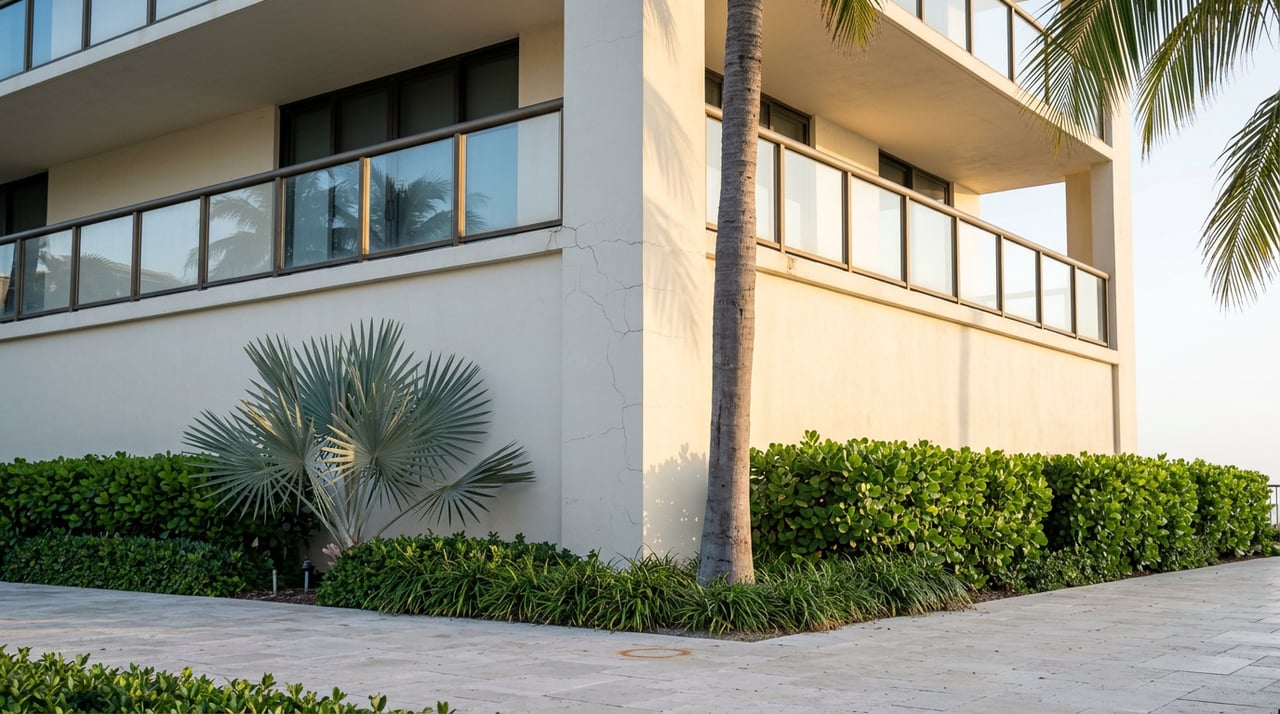
A buyer under contract on an older Key Biscayne tower this year is more likely than at almost any point in the past decade to open an estoppel letter days before closing and find a number that was not in the listing. Not because the building suddenly failed an inspection. Because the board finally lost the legal right to keep waiving the reserve funding it had been waiving for years. That is the mechanism worth understanding before you write an offer on the island, and it is different from what most condo guides describe.
Every national explainer on Florida's post-Surfside condo laws tells you the same broad strokes: milestone inspections for buildings three stories and up, a Structural Integrity Reserve Study to fund future repairs, and a hard deadline tied to 2026. What almost none of them tell you is how the coastal rule actually plays out on an island where nothing sits more than three miles from the water. On Key Biscayne, the 25-year trigger is not the exception. It is the rule, and it has been for decades. The real disruption isn't the inspection requirement. It's what happens to a board's budget the moment it can no longer defer.
The island crossed this threshold long ago
Florida's original 2022 law set the milestone inspection trigger at 30 years for most buildings and 25 years for anything within three miles of the coast. Because Key Biscayne is entirely coastal, its older condo stock crossed that line years before this legislation even existed. Look at when the island's original towers went up:
| Building | Year Built | Approx. Years Since Construction |
|---|---|---|
| Governors Lodge | 1963 | 63 |
| Galen Breakers | 1969 | 57 |
| The Sands | 1969 | 57 |
| Towers of Key Biscayne | 1971-72 | ~54-55 |
| Casa Del Mar | 1971 | 55 |
| Key Colony (Tidemark, Oceansound, Emerald Bay, Botanica) | 1979-81 | ~46-47 |
| Bahia Mar | 1983 | 43 |
None of these buildings are waiting on a first inspection. Most have already gone through decades of Miami-Dade's older 40-year recertification cycle. Sam Schrager, president of The Sands Condominium Association and of the Key Biscayne Condominium Presidents Council, has described his building as the island's second-oldest tower after Island House, and noted it has already completed both its 40-year and 50-year recertifications. That is the pattern across most of the island's original stock: the inspections themselves are not new. What changed is what the law now requires those boards to do with what the inspections find.
The waiver that ran out
For years, a condo board could vote every budget cycle to underfund or waive reserves for major structural components: roofs, load-bearing elements, waterproofing, plumbing, electrical. That flexibility is why so many older buildings kept dues artificially low for so long. The law closed that door in stages. Budgets adopted before the end of 2024 could still waive those reserves. Budgets adopted from January 1, 2025 onward could not. Full funding at the level the reserve study calls for was required to begin January 1, 2026.
That sequencing matters more than a building's age. A 1960s tower that funded its reserves properly the whole way through, the way Schrager describes The Sands, walks into 2026 with a manageable line item. A newer 1980s tower that spent decades voting to keep dues flat walks into the same year facing a bill it deferred for a generation.
Brickell Key's Isola Condominium is the clearest documented example of what that catch-up looks like in practice. A resident there described a $19 million assessment tied to years of neglected pool deck and garage repairs, with an individual share close to $40,000, layered on top of a 60 percent dues increase the prior year and another 30 percent increase on top of that. The building is not on Key Biscayne, but the mechanism is identical to the one now working through boards across the county: reserves that were legal to skip for a long time are no longer legal to skip, and the money has to come from somewhere.
"I tell people that we have probably been fooling ourselves for a long time, and now, climate change and Champlain Towers has brought us reality."
That was Schrager's read on the shift, and it captures the reframe better than any statute citation. The question for a buyer is no longer "is this building old" but "did this board pay ahead or fall behind."
What the law actually lets you ask for
Florida Statute 718.503 gives a prospective condo buyer a specific right before signing: a copy of the inspector-prepared milestone inspection summary if one exists, and the association's most recent Structural Integrity Reserve Study, or a written statement that none has been completed. Two documents, not a vague promise of transparency.
Before making an offer on any Key Biscayne condo built before the mid-1990s, request:
- The milestone inspection summary report, and whether the building has been through Phase 1 only or also Phase 2
- The current SIRS or reserve study, including the funding schedule for the eight structural components the law protects from waiver
- Board meeting minutes from the past 12 to 18 months, since that's typically where a pending assessment shows up before it becomes an estoppel line item
- The association's most recent budget, and the date it was adopted, since that single date determines whether reserve waivers were still legally possible when it passed
That last point is the one most buyers skip. A budget adopted in November 2024 tells a very different story than one adopted in January 2026, even for the same building.
Reading the market through this lens
Key Biscayne's broader housing market has softened this year in ways that line up with this reset. Redfin reported a median home sale price of $1.4 million in March 2026, down 24 percent from the same month a year earlier, with the typical home taking 183 days to sell compared to 105 days the year before. Some of that is ordinary supply and rate dynamics. Some of it, particularly on the condo side, is buyers pricing in exactly the reserve-funding catch-up described above. A unit that looked fairly priced against last year's comps can carry a materially different monthly cost once a building's post-waiver dues take effect.
That doesn't mean older Key Biscayne buildings should be avoided. It means the building's paperwork now tells you more than its exterior does. A well-managed association that funded reserves honestly for decades is arguably a safer long-term hold than a newer building with a thin financial history, because you can actually verify the former's discipline in writing.
A few questions worth asking directly
If a building passed its milestone inspection, does that mean no special assessment is coming? No. A passed inspection means no substantial structural deterioration was found during the visual review. It says nothing about whether the association's reserves are funded at the level the SIRS requires. Those are two separate questions, and the second one is usually the one that produces a surprise bill.
Does a 2026 SIRS deadline apply to every Key Biscayne building? The outer deadline of December 31, 2026 applies specifically to associations whose milestone inspection is also due by that date, allowing the two processes to run together. Most of the island's original towers completed their SIRS earlier, since they had already crossed the 25-year coastal threshold well before this law existed. The more relevant date for most buyers now is January 1, 2026, when full reserve funding became mandatory regardless of when the study itself was finished.
Is a pre-1990s building on Key Biscayne still worth considering? Plenty of them are, and several, based on public statements from their own board leadership, have funded reserves responsibly for years. The point isn't to avoid older buildings. It's to stop treating a building's age as the risk signal and start treating its budget history as the actual one.
If you're evaluating a specific building on Key Biscayne and want a second set of eyes on its reserve study or board minutes before you write an offer, I'm happy to walk through it with you. Reach out through Jonathan Garcia and let's connect before you're the one opening that estoppel letter.